Pinocchio’s lies make his nose grow
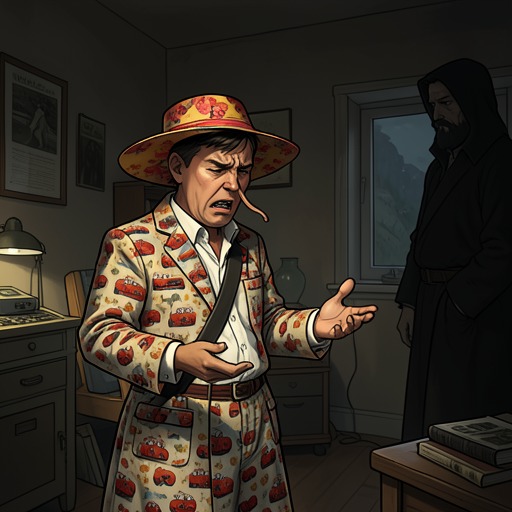
The Adventures of PinocchioPinocchio’s lies make his nose grow in a comic but unmistakable lesson in how dishonesty turns a concealed truth into a visible obstacle. While recovering in the care of The Fairy with Azure Hair, he invents successive explanations for the five gold pieces meant for Geppetto; each falsehood lengthens his nose until he cannot leave the room. The Fairy ultimately calls on woodpeckers to restore it, but not before the deception has become impossible to hide.
Background and the story Pinocchio tells
The episode follows a small medical crisis. Pinocchio eats sugar but refuses the medicine The Fairy with Azure Hair offers him. When black rabbits arrive carrying a black coffin, he is frightened into drinking it and feels better. The Fairy then asks him to explain how he came into the Assassins’ hands, giving him the opportunity to account for the danger that preceded his illness.
Pinocchio says that Fire Eater gave him five gold pieces to take to his father. On the way, he met the Fox and the Cat, who persuaded him that the money could become two thousand if he went with them to the Field of Wonders. He recounts stopping with them at the Inn of the Red Lobster, where they ate and slept; when he awoke, his companions were gone. He says that two Assassins demanded his money or his life, that he hid the coins under his tongue, and that one attacker reached into his mouth. Pinocchio claims he bit off what he thought was a hand, only to discover it was a cat’s paw, and that the Assassins later caught and hanged him, intending to return for the coins.
His account sits against an earlier pattern of dismissing warnings. Before meeting the Assassins, Pinocchio had reasoned that they were a story invented by parents to frighten children who ran away at night; he also imagined he could simply challenge them or flee. The danger he had treated as a parental scare becomes part of his own account to the Fairy. His version describes the peril, but it does not explain what happened to the gold pieces, which remain the question that exposes his dishonesty.
Three lies, three enlargements
When The Fairy with Azure Hair asks where the gold pieces are, Pinocchio answers, “I lost them.” The answer is false: he still has them in his pocket. His nose, already long, immediately grows by at least two inches. Asked where he lost the money, he says it was in the nearby wood, and another lie makes his nose grow a few inches more.
The Fairy answers that anything lost in that wood can be found. Pinocchio, increasingly confused, changes his story again, claiming that he swallowed the coins when he drank the medicine. The third lie brings the greatest enlargement. His nose becomes so long that turning to the right sends it against the bed or windowpanes; turning left makes it strike the walls or door. Raising it risks hitting The Fairy with Azure Hair in the eyes. The falsehood is no longer just a spoken evasion: it has taken up space, interferes with movement, and prevents Pinocchio from leaving.
The progression makes the physical consequence cumulative. Each answer attempts to cover the previous one, but instead of restoring concealment, it adds to the evidence against him. Pinocchio cannot even escape the room to avoid facing the result: his nose will not fit through the door. He cries for hours over its length, while the Fairy initially withholds help because she wants him to learn from the experience.
The Fairy’s lesson and the nose’s restoration
The Fairy names the distinction at the heart of the scene: “There are two kinds of lies, lies with short legs and lies with long noses. Yours, just now, happen to have long noses.” The line turns the nose into a visible measure of Pinocchio’s successive fabrications. His words are not treated as private mistakes that disappear once spoken; their effect is made public on his own body, and the growing nose makes evasion harder rather than easier.
The punishment also has a limit. Seeing Pinocchio pale with fright and terrified by the nose that blocks his escape, The Fairy with Azure Hair takes pity on him. She claps her hands, and a thousand woodpeckers fly through the window and peck at the enormous nose until it returns to its former size. The magic that amplified his deception is thus reversed by another magical intervention, but only after the lesson has been made vivid. Pinocchio dries his eyes, thanks the Fairy, and tells her how much he loves her; she answers that she loves him too and offers to let him stay as her little brother, with herself as his good little sister.
Narrative role and significance
The scene joins a physical gag to a direct moral explanation. The nose grows by inches, bangs into furniture and walls, threatens the Fairy, and finally cannot pass through a doorway: the increasingly absurd spectacle makes the danger of lying entertaining while keeping its consequence concrete. The Fairy’s saying gives the incident a memorable formulation, but the action has already shown what it means. Pinocchio’s lies do not solve the problem of the missing coins; they make his predicament larger and harder to escape.
The episode also fits the broader pattern of Pinocchio’s resistance to advice and his later recognition of its cost. In another moment of danger, after a schoolmate is injured, he regrets listening to bad companions and recalls warnings from his teacher and mother. That later remorse does not change what happens in the Fairy’s room, but it echoes the gap between hearing a warning and acting on it. Here, the gap is compressed into a sequence: a question, a false answer, a longer nose, and a door he cannot get through. The Fairy’s rescue restores his appearance and affection between them, while the incident leaves the lesson attached to an image that cannot be overlooked.